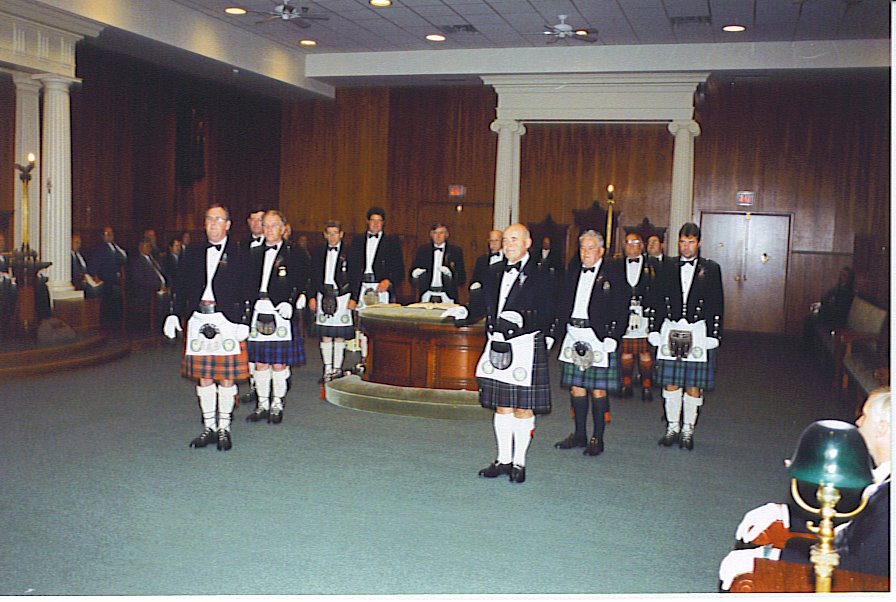
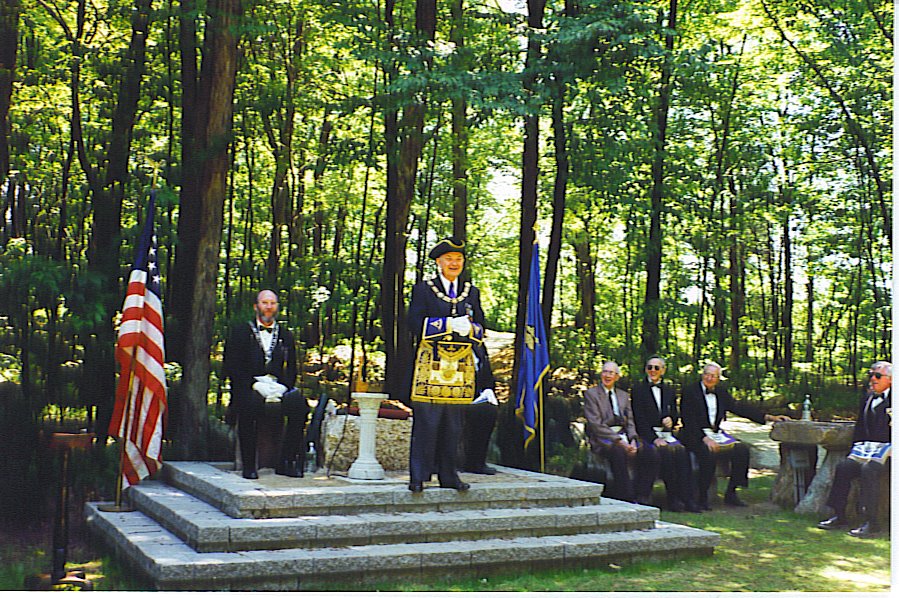
Joppa Lodge #150


Gandhi’s Top 10 Fundamentals for Changing the World
Published by Henrik Edberg May 9th, 2008 in Personal Development, People Skills, Lessons I have learned from... and Success.
“You must not lose faith in humanity. Humanity is an ocean; if a few drops of the ocean are dirty, the ocean does not become dirty.”
“The difference between what we do and what we are capable of doing would suffice to solve most of the world’s problem.”
“If I had no sense of humor, I would long ago have committed suicide.”
Mahatma Gandhi needs no long introduction. Everyone knows about the man who lead the Indian people to independence from British rule in 1947.
So let’s just move on to some of my favourite tips from Mahatma Gandhi.
1. Change yourself.
“You must be the change you want to see in the world.”
“As human beings, our greatness lies not so much in being able to remake the world - that is the myth of the atomic age - as in being able to remake ourselves.”
If you change yourself you will change your world. If you change how you think then you will change how you feel and what actions you take. And so the world around you will change. Not only because you are now viewing your environment through new lenses of thoughts and emotions but also because the change within can allow you to take action in ways you wouldn’t have – or maybe even have thought about – while stuck in your old thought patterns.
And the problem with changing your outer world without changing yourself is that you will still be you when you reach that change you have strived for. You will still have your flaws, anger, negativity, self-sabotaging tendencies etc. intact.
And so in this new situation you will still not find what you hoped for since your mind is still seeping with that negative stuff. And if you get more without having some insight into and distance from your ego it may grow more powerful. Since your ego loves to divide things, to find enemies and to create separation it may start to try to create even more problems and conflicts in your life and world.
“Life is a decision conveyer. It conveys to the world the decisions that you’ve made about yourself. It tells people what you’ve decided about who you are, and who they are, and why you are here, and why you think they are here, and what life itself is about.”
“These decisions have greater impact than you could ever guess. They touch people in ways that go far beyond what you might have imagined.”
“Yet it does not begin by trying to change the world. It begins by seeking to change the self. Change the self and your inner world changes. And when your inner world changes, the outer world that you touch changes, little by little. And when the outer world that you touch changes, the world that it touches changes, and the world that it touches. Outward and outward and outward this spreads, like a ripple in a pond.”
“When what you are doing is a reflection of what you are being, rather than an attempt to create what you wish you were being, you will know that you have produced lasting change in yourself. This is what produces lasting change in the world.”
Neal Donald Walsch in talking about Gandhi says this:
“First he attained a state of being. This is work that he did from within. Then, and only then, did his outward ‘doing’ become the kind of ‘doing’ that changed the world.”
“He did not achieve a state of being as a result of what he was doing. What he was doing reflected the state of being he had achieved.”
Brother Milliken, I thank you for your reply to my post on
recognition. I did not take them as criticism and I am glad that my
post has started some good conversations about this topic. My
original post was due to having been told by a brother that there are
no African Americans in the Tennessee lodges and not to bring any to
the lodge to petition for membership. I was told that they have their
own lodge and we have ours and that was that. Well, not being raised
that way I started to ask questions and got the same answers. The
reason that it came back up to me is that I received an announcement
that there will be a cave degree and, I noticed at the bottom of
the announcement it stated that the Tennessee GL dose not recognize
the Prince Hall Lodge. That stuck in my craw. Then after that, I
found out that an African American man had been discouraged form
joining our lodge. I have heard of several good masons quitting our
lodge due to this and, I am thinking about doing the same. My
original thought was to stay in and try to change it but, I think the
odds are stacked against me. I and another MM are in the process of
figuring out what we are going to do. I do hate hypocrisy.
Thanks again.
Fraternally.
Brother X
It is interesting that you should mention that you demitted from Mainstream Masonry and joined Prince Hall. A friend and I who are going through the officer seats have been talking about the racism problem in our Grand Lodge and our Lodge and, that is one of the reasons that I am leaving the seats. I have also been talking about Demitting and joining Prince Hall. I have only met one Brother from the Prince Hall Lodge and I am trying to get back in touch with him. Be it as it may, there is a time to take a stand and this is the time.
Fraternally,
Brother X
Sadly, new McCarthyism has invaded Freemasonry. The “new McCarthys” use the racist label to explain why any individual Freemason or Grand Lodge would be opposed to recognizing Prince Hall Affiliated (PHA). They ignore the fact that the Doctrine of Exclusive Territorial Jurisdiction (ETJ) is a real doctrine that predates the existence of PHA. They ignore the fact that ETJ has been generously applied to other bodies that were not primarily made up of men of African descent. They ignore the possibility that mutual recognition of more than one body within the same political boundaries sets a precedent that could come back to haunt the Fraternity – ie: the day when Prince Hall Origin (PHO) begins to make a case for recognition.
Could it be that the Grand Lodge’s that have agreed to mutual recognition with PHA have simply folded to new McCarthyism? Did they ignore the tried and true Doctrine of ETJ just to avoid the stigma of being labeled racist? Which label will they roll over for next? Will it be “sexist?”
For some 200 years, U.S. “mainstream” Grand Lodges taught their members that Prince Hall Masonry was irregular. Visitation between “mainstream” US lodges and Prince Hall lodges was not allowed as no Prince Hall Grand Lodge was recognized as regular. We were taught that there were legitimate reasons why Prince Hall Masonry was irregular. Now we are taught that there is nothing at all irregular about Prince Hall Masonry. Recognition between the majority of US “mainstream” Grand Lodges and their Prince Hall counterparts now exist. Even where fraternal relations do not exist, we are led to believe that some Grand Lodges have made official statements declaring Prince Hall Masonry to be regular, if not always recognized. Did Prince Hall change in its nature? No. Then what gives? How does any thinking Mason reconcile this apparent contradiction? If being irregular means that something is wrong with a Masonic body, then how can it be declared regular if nothing has changed in the body? If we wish to take the position that it was simply an honest error in regard to Prince Hall, then we must face the fact that it was a pretty big error that for roughly 200 years falsely labeled and denied recognition to true brothers. Is there another reason (or reasons) why Prince Hall Masonry was falsely labeled “irregular”? Is it unreasonable to seek an understanding of this question? Is it unreasonable to wonder if, even today, “mistakes” could be made with other Masonic bodies?
One of the major problems with understanding the issues of regularity is our use (or misuse) of the word “irregular.” Common use has made the words “irregular,” “clandestine” and “unrecognized” interchangeable. But are they always interchangeable? Logic dictates that since Prince Hall Masonry (having made no change in their nature or organization) has been confirmed by the majority of U.S. Grand Lodges to be perfectly regular, then they were factually “unrecognized,” but not “irregular.” If this is the case, then why were they almost always called “irregular” and “clandestine”?
Prince Hall Masonry was not kept outside of the recognized Masonic family for some 200 years because of legitimate reasons, but because of an intentional desire to keep them out. In order to keep up the appearance of remaining true to the teachings of Freemasonry, Grand Lodges freely accepted the charges that Prince Hall Masonry was justifiably irregular. Since most Masons were not researchers, it was not that hard to write legitimate sounding charges against Prince Hall Masonry. In addition, because the vast majority of the Prince Hall Masons were black, there was no real desire to closely examine the charges made against them. When one spoke or wrote about Prince Hall Masonry, the words “irregular” or “clandestine” were used with no attempt to prove that the charges were factual. It was enough to just keep saying that Prince Hall Masonry was irregular. It was not true, but it was always there and accepted by most all. Even among those who held no bigotry in their hearts, the charges against Prince Hall Masonry were commonly accepted. Why? Because we trusted that our leaders would not tell us anything but the truth. We are Freemasons. We don’t speak evil of our brothers, right? How could such an organized effort of deception take place?
Exclusion and Non-Recognition
During most of US history, black persons were systemically excluded or segregated, in all social associations. This was clearly contrary to the "self evident truth that all men are created equal". And it was certainly contrary to the Masonic maxim that all Masons, if not all persons, are Brothers, Equal and Free. In US Freemasonry, not only did black and white streams run parallel and separate, but the prevailing view held by respected and influential white Masonic writers, teachers, and leaders was that a black person was ineligible for Freemasonry.
This exclusion was defended, simultaneously, by the argument that Masonic doctrine demanded it (Claudy), and that, although Masonic doctrine forbade it, it was necessary to maintain "peace and harmony" in the lodge (Haywood, Mackey).
Thus, whereas exclusion led to separate institutions and non-recognition of the black (Prince Hall) institutions by the white (mainstream) ones, the polite arguments given were "peace and harmony" and "exclusive territorial jurisdiction", respectively.
These attitudes, practices, and policies persisted long after the US signed the Universal Declaration of Human Rights: "1. All human beings are born free and equal in dignity and rights. They are endowed with reason and conscience and should act towards one another in a spirit of brotherhood. 2. Everyone is entitled to all the rights and freedoms set forth in this Declaration, without distinction of any kind, such as race, colour, sex, language, religion, political or other opinion, national or social origin, property, birth or other status." -- Universal Declaration of Human Rights, adopted world-wide, without dissent, 1948.
It should be noted that this attitude was one-sided. Whereas the white policy of black exclusion is well-documented, the black institutions had an explicit policy of inclusion and of recognition. Prince Hall himself gave this Charge to African Lodge in 1797: "give the right hand of affection and fellowship to whom it justly belongs let their color and complexion be what it will, let their nation be what it may, for they are your brethren, and it is your indispensable duty so to do; let them as Masons deny this, and we & the world know what to think of them be they ever so grand". And the 1904 Prince Hall Credo states: "I believe in Prince Hall Masonry, a door of benevolence securely tiled against the unworthy, but opened wide to men of good report, whether Aryan or Hottentot."
Inclusion and recognition (in non-trivial numbers) in mainstream US Freemasonry began in the 1980s, and, after 19 years of recognition efforts, 80% of US Grand Lodges recognize at least one Prince Hall Grand Lodge. However, 58% of the 160,000 Prince Hall Masons remain totally unrecognized by *any* US mainstream Grand Lodge. The "reason" is that the mainstream GLs won't recognize a PH GL unless it is recognized by the white GL in the same State. This is called "The American Doctrine of Exclusive Territorial Jurisdiction". The following 11 States remain thus excluded: AL AR FL GA KY LA MS NC SC TN WV. The majority of all PH Masons live in those 11 States.
Even the United Grand Lodge of England, which does not practice this American Doctrine itself, respects it and will not recognize the Prince Hall Grand Lodges thus excluded by their white counterparts.
In contrast, all the Australian Grand Lodges have fraternal relations with *all* Prince Hall Affiliated Masons, and the same is true for some of Canada.
Even in Canada, far North of the Mason-Dixon Line, there remains one mainstream Grand Lodge which still does not recognize the Prince Hall Grand Lodge in the same territory. Some of its leaders have even dis-acknowledged its very existence.
Outside the US (and parts of Canada), Freemasons are shocked by such official policies and systemic practices. And many, if not most Masons in North America are ashamed and deeply disturbed by these facts. Even after 20 years of recognition efforts, only a small percentage of the possible Masonic handshakes between black and white Masons are "legal". In Canada, the degree of completion of Prince Hall recognition is only 1.5%, even though, in 1992, *all* Canadian Grand Masters agreed to accept *all* Prince Hall Affiliated Masons as *Regular* Masons. The corresponding metric in the US is still very small, and, at the rate of progress over the past 20 years, full recognition could take another century.
Ultimately, an explanation for the persistence of exclusion and non-recognition can be found in what Mackey's Encyclopedia approvingly calls the "dogmatic and autocratic" system of Grand Lodge governance in the US and (parts of) Canada.
Another part of the explanation is that many refuse to acknowledge that 200 years of exclusion and non-recognition was a unilateral and systemic *wrong* that needs to be stopped promptly, unilaterally, and completely. Many refuse to acknowledge that there ever *was* any race-based exclusion in US Freemasonry, because such an exclusion would be a perversion of the very essence of Freemasonry:
Denial of Brotherhood perpetuated by the denial of the perpetual denial of Brotherhood.
TSMR: Prince Hall Freemasonry Recognition (in Canada, in Context)